The Steward's Desk · Investing
The behavior gap: why investors trail their own funds
Morningstar keeps finding the same pattern. Closing it has less to do with picking funds and more to do with holding them.

Jesse Plunkett, CEPA®, CRPC®
July 12, 2026 · Meet your advisor · 
What is the behavior gap?
The behavior gap is the difference between what a fund earns and what its average investor earns in it. Morningstar's Mind the Gap 2025 study, covering the 10 years ended December 31, 2024, found the average dollar in US funds earned 7.0% a year while the funds themselves earned 8.2%, a gap of 1.2 percentage points a year, mostly because of when money moves in and out.
That finding is easy to misread, so it helps to slow down. A fund's published return assumes one dollar invested at the start and left alone. Your actual return depends on when your dollars arrived and when they left. If money tends to show up after the good stretch and leave during the bad one, you can own a fine fund for a decade and still trail it the whole way.
Morningstar measures this with dollar-weighted returns, which follow the experience of the actual dollars in the fund rather than the fund's brochure math. The distinction sounds technical, but it answers a question I hear often: how can the investors in a good fund have done worse than the fund itself? Because the crowd's money showed up late and left early, and the average carries those scars.
More than a percentage point a year sounds small. Compounded across a working lifetime, a gap that size adds up to a meaningful share of what a portfolio could have produced, which is why I treat behavior as a core part of the investing job rather than a soft skill on the side.
Why does the gap exist?
Because money tends to move at the wrong moments. Investors add money after markets have already run up and pull it out after they've already fallen, so their dollars catch less of the recovery and more of the decline. Each move feels reasonable in the moment. The pattern only shows up in the aggregate, years later.
None of this makes anyone foolish. A falling balance produces a sense of danger that a rising one never quite balances out, and the financial press earns its living amplifying both directions. Some of the gap is mechanical too: bonuses arrive and get invested at whatever price January offers, and cash needs force sales on the market's schedule instead of yours.

Why doesn't "this time is different" hold up?
Every downturn arrives wearing a new mask, and in some narrow way it truly is different. The cause changes each time: a pandemic, a bank failure, an oil shock, a bursting bubble. So the feeling that this one is different is not a delusion. It is technically true every single time. The trouble is the leap from "the cause is new" to "the outcome will be different," because the record runs the other way. There have been hundreds of moments when serious people were certain the old rules no longer applied, and given enough time, broadly diversified markets have recovered from every one of them so far. History is not a guarantee, but it is the best evidence we have, and it points in one direction. Treating "this time is different" as a reason to sell bets against the one pattern that has held over every long horizon we can measure.
Why are "wait and see" the most dangerous words in investing?
"Wait and see" sounds careful. In practice it almost always means "I will invest again once the market has recovered," and that is the trap, because the market does its recovering while the news is still frightening. Prices turn up well before the danger feels over, so the person waiting for an all-clear buys back higher than they sold, if they buy back at all. Markets care far more about what is coming than about what is happening today. They move on expectations, not headlines.
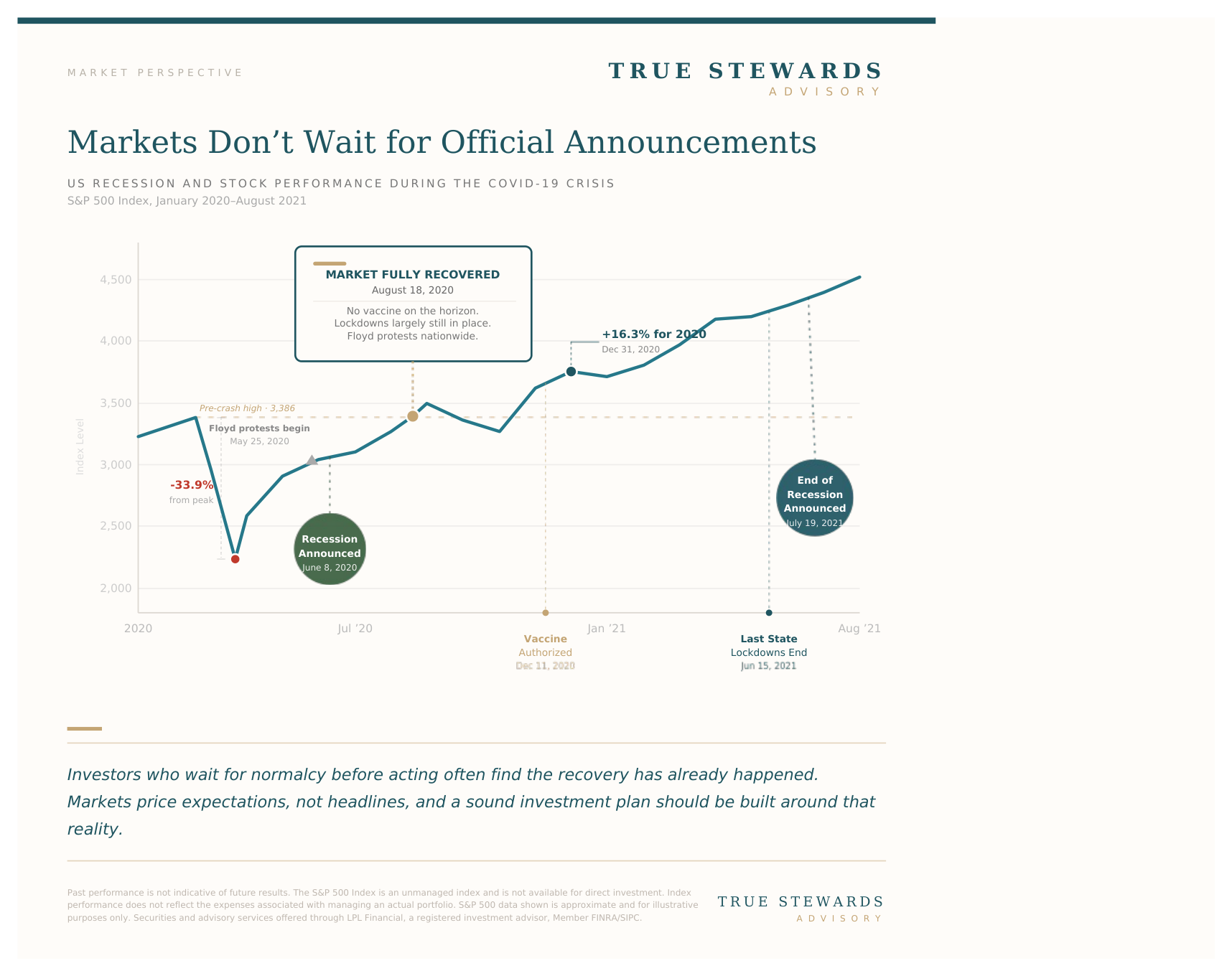
The spring of 2020 is the cleanest example I know. US stocks fell about 34% as the pandemic hit, then bottomed and began climbing on March 23, 2020. By August 18, 2020 the S&P 500 had erased the entire decline, at a moment when there was no vaccine, lockdowns were still widespread, and the headlines were as grim as they had been all year. The official word that a recession had even begun did not arrive until June 8, 2020, after the market had already turned, and word that the recession had ended came in July 2021, more than a year after stocks recovered. Anyone waiting for life to feel normal before reinvesting watched the rebound happen without them.
This is why the plan I build with clients assumes the frightening moment in advance. If you have decided ahead of time to keep buying on schedule and to leave the portfolio invested through a downturn, "wait and see" never gets a vote, because the decision was already made from a calm chair on an ordinary day. None of this guarantees the next recovery looks the same or comes as quickly. It simply argues against handing your plan to the one emotion that has cost investors the most.
What closes the gap?
Three things, in order of power: automation, understanding, and a circuit breaker. Automatic contributions invest on schedule regardless of headlines. A portfolio you understand is one you can hold while it's falling. And a standing rule, or a person, that makes you pause before any big move catches most of the rest.
Automation is the strongest tool because it removes the decision entirely. Your 401(k) already proves the point: payroll contributions kept buying through every scary headline of the past decade without asking how you felt about it. Extending that same autopilot to your IRA and brokerage account puts more of your money on a schedule and less of it on your mood.
Understanding is the second layer. A portfolio you could explain to a friend, this much in stocks for growth, this much in bonds for stability, is one you can hold through a rough year, because a falling price reads as a sale on something you chose rather than a verdict on something you gambled.
Rebalancing on a calendar adds one more guardrail. When the plan says to restore your target mix every year, you end up trimming what has run up and adding to what has fallen, on schedule, without anyone needing to feel brave that day.
The third layer can be a person, and I'll be plain about my interest here: this is part of what clients hire me for. Before anything big moves, we walk through what the plan says and what has actually changed. You can build the same pause yourself with a written rule and a 48-hour wait. What you can't do is hand the job to willpower in the moment, because that's the exact resource the gap feeds on.
Want a plan you can hold through a rough market?
Building that structure, and being the call you make before big moves, is the heart of how I serve clients. A short call is the place to start.
- Nothing to buy or sign
- No fee of any kind
- Nothing to prepare or bring
Common questions
Is the behavior gap caused by owning bad funds?
No. You can own excellent funds and still trail them. The gap measures timing: when your dollars entered and left, compared with what the fund did over the whole period. That's why the fix is about behavior and structure, not about swapping one fund for another.
Does the behavior gap apply to index fund investors?
Yes. An index fund removes the stock-picking question, but it can still be bought after a run-up and sold in a panic. Morningstar's research finds the gap is smallest where investing happens automatically, like target-date funds inside retirement plans. The wrapper helps; the habits decide.
How do I know if the gap is costing me?
Look at your own history rather than your feelings. Did you stop contributions during a downturn, sell after a drop, or hold a bonus in cash waiting for a better moment? Those are the behaviors that create the gap. If your contributions ran on schedule through the last rough market, you're likely already on the right side of it.
Can working with an advisor eliminate the behavior gap?
No one can promise that, and I'd be careful with anyone who does. What an advisor adds is structure: automatic contributions, a written plan you understand, and a required conversation before big moves. That manages the risk of poorly timed decisions without eliminating it. The Morningstar finding is a pattern, not a life sentence.